
A naturally reclusive nature and a conviction for the work to do the talking meant there was very little known about Mistry even during his time at the helm of Tata Sons. He did not do a single media interview from Bombay House.

The top court drew parallel between driving and technology and said if one doesn't know how to handle technology then he or she can't be a judge and questioned the approach of some of the high courts.

Sources close to the development said a significant amount of around Rs 7,000 crore had been put into the SBI account with a proposal on escrow of the deposited funds.

The apex court said Ambani and the others will have to purge contempt by paying Rs 453 crore to Ericsson in four weeks. A bench comprising Justices R F Nariman and Vineet Saran said if the 'contemnors' failed to make the payments within the specified period, they will undergo a jail term of three months.

The government appears serious about its intent to do away with the sore points in the taxation laws.


The auditors -- the local arms of the Big Four global firms Deloitte Haskins & Sells and KPMG which has BSR & Associates as an affiliate here-had challenged the jurisdiction of the NCLT to ban them.

With the Jaypee acquisition, the Suraksha group, which made lenders an offer of Rs 7,736 crore, will be able to expand its footprint in north India after making inroads in Mumbai's real estate market over the past year. Sudhir Valia, the promoter, was a co-founder and executive director of India's biggest pharmaceutical firm, Sun Pharmaceuticals, and is a close relative of Dilip Shanghvi.

Seeking ArcelorMittal be declared ineligible to bid for Essar Steel, the petition cited Section 29A of the Insolvency and Bankruptcy Code which bars promoters of defaulting companies from bidding for stressed assets.
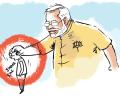
'By not only decriminalising routine business failures, but by ensuring that institutional lending and corporate rescue frameworks are strengthened via the IBC, the prime minister has ensured there is no room anymore for the proverbial 'reckless, prodigal debtor',' notes Sanju Verma.

The Supreme Court on Friday set aside NCLAT order of December 18, 2019 restoring Cyrus Mistry as executive chairman of Tata Group.

Looking beyond the lesser penalty regime, in its 10th year of existence, the CCI needs more branches, according to experts

Insolvency and Bankruptcy Code bound stocks have witnessed a steep fall in 2018.

As NCLAT chair, lack of basic infrastructure remains Justice Mukhopadhaya's biggest challenge. The lack of permanent staff to take down orders in shorthand and later type them out for him to correct is just one among many. In cases where there are a number of intervening parties and applicants, the courtroom is often so jam-packed that even the senior advocates have failed to find place inside.

The time-bound nature of the bankruptcy code, envisaging resolution within 180 to 270 days, would put enormous pressure on the existing judicial infrastructure.

Future Retail's independent directors had last week asked Amazon if it was willing to give a long-term loan to avoid default on repayment of Rs 3,500 crore loan due on January 29. Amazon replied to that saying it was willing to financially assist Future Retail through the Samara Capital deal but the retailer must shelve Rs 24,713 crore deal with the Reliance group.

According to a government reply in Lok Sabha, as on June 30, 2017, there were about 109,598 cases pending across debts recovery tribunals, with recovery dues of Rs 635,500 crore.

When powers vested by the Finance Bill 2017 begin to get mildly used, fellow Indians living in the corporate bubble will get a faint whiff of what life can be like when you run a grocery store in the streets of Kashmir or the North East.

'Power is always transitory, and you should be the same person whether you have it or not,' the head of the number one law firm in India tells Pavan Lall.

Almost 2,000 companies whose private provident and pension funds have invested in non-convertible debentures of IL&FS group firms are staring at the prospect of booking losses to the tune of Rs 9,000 crore or more if the interest income is added.

Pawan Ruia has finally done it, a beaming Buddhadeb Bhattacharjee, then West Bengal chief minister, had said at the reopening of the 70-year-old Sahagunj factory owned by Dunlop in 2005. But with the Calcutta high court passing a winding-up order in 2013 and the Trinamool Congress-led state government passing a Bill to take over the company in 2016, the once-upon-a-time undisputed leader in the Indian tyre industry looks vastly undone. But that can hardly be a deterrent for Ruia, who has a penchant for making headlines one way or the other.

Around 241 companies were sent for liquidation under the IBC by various NCLT benches and in only 58 cases have the resolution plans been accepted

A declining rupee, elevated crude oil prices and sustained foreign fund outflows added to the gloom

Vodafone's long-pending tax dispute with the government might be heading for a resolution, with the finance ministry considering changing the Income-Tax Act's retrospective amendment and taxing indirect transfer of assets prospectively from 2012, the year the law was clarified.
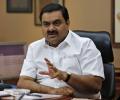
Markets regulator Sebi and the Directorate of Revenue Intelligence (DRI) are probing some Adani Group companies for alleged non-compliance with rules, the government told Lok Sabha on Monday. Minister of State for Finance Pankaj Chaudhary in a written reply to a question said accounts of three of the six Mauritius-based funds, that have invested most of their money in Adani Group firms, were frozen in 2016 over the issuance of Global Depository Receipt (GDR) by certain listed firms. No freeze was ordered for their holding in other firms.
While passing the scrutiny of courts is a tough challenge, with eight proposed amendments to the insolvency law, the government has sought to turn the focus back on at least some of the functions of the bankruptcy law.

Tamal Bandyopadhyay offers some unsolicited advice for a government wh,ich came to power, with brute majority and the nation's pragmatic chief money man.

With real estate valuations falling and other deals coming unstuck, the current management's improved target faces significant challenges.

The justice delivery system is struggling to cope, creaking at the joints and bursting at the seams. Indian courts have to deal with about 30 million cases with a judicial strength of just about 19,000 judges.

The infra-major going belly up cracked open some major flaws in the system - the most evident being weak corporate governance and how layers of corporate structures could be formed adding to the opaqueness of the group.

Valuers have found almost no assets to pay for their claims against the Videocon group that entered the insolvency process in 2018. But the dissenters suggest that the money is elsewhere, possibly in the group's oil and gas assets, which are not part of the group's bankruptcy case.
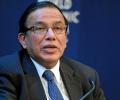
The account turned bad before Chaudhari took over as SBI chairman and the asset was sold to AARC following an open bidding process, months after Chaudhari retired, explains Tamal Bandyopadhyay.
Bankers say debt resolution bills are coming high as resolution professionals are giving the human resources and audit/legal consulting to outside firms to plug all the loopholes.
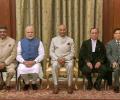
The momentum created by the landslide victory of the ruling party should be utilised to carry forward reforms in the legal field, says M J Antony.

The government will come out with proposed modalities and terms of references for setting up grievance appellate committees to address social media users' complaints in the next 10-12 days, and expects the panel to be in place by November 30, Union Minister Rajeev Chandrasekhar said on Tuesday.

Finance Minister Nirmala Sitharaman on Monday presented the Budget for 2021-22 in the Lok Sabha that is expected to provide relief to the pandemic-hit common man as well as focus more on driving economic recovery through higher spending on healthcare, infrastructure and defence amid rising tensions with neighbours, As India emerges from the COVID-19 crisis, the ninth Budget under the Modi government, including an interim one, is widely expected to focus on boosting spending on job creation and rural development, generous allocations for development schemes, putting more money in the hands of the average taxpayer and easing rules to attract foreign investments.

Vodafone, according to sources, in its response to the Finance Ministry's offer for conciliation, had expressed keenness to settle the long-pending capital gains tax dispute.

The sluggish legal system in India makes it extremely difficult for law-enforcing agencies in the ministry of finance to punish violations of foreign exchange laws. Unfortunately, it is not just FEMA. The Prevention of Money Laundering Act too has significant infirmities, say Paranjoy Guha Thakurta and Pranati Mehra.

Representatives of the British telecom company on Friday met senior finance ministry officials, in search of an amicable solution.

'NSE has thousands of employees. It is their institution. So it's a dear family.' 'One should not hurt the morale of these people.'
